From Cloud Custodian to Token Custodian: What Ten Years Taught Us About AI Spend
Recently we announced Stacklet Token Custodian, a control plane for attributing and governing AI token spend.
AI is the biggest shift in infrastructure since the cloud. When cloud arrived, any team could spin up infrastructure with a credit card and an API call. Adoption outran control. Bills grew faster than anyone could explain them, and governance had to catch up.
AI is following the same path, only faster. What took cloud a decade is happening with AI in a couple of years. Developers use coding assistants every day. Finance and operations teams use AI in their daily work. AI agents write code, answer customers, and run multi-step tasks, often without a person approving each call. Most companies still learn what all of it costs when the invoice arrives. Measuring what it’s worth is harder. Making sure the spend goes to the right work, on the right model, under the right guardrails, is still harder.
Cloud Custodian started with one question: how do you let teams move fast and still keep the organization well-managed? AI asks it again. Here’s what we built into Cloud Custodian and Stacklet that we’re now bringing to AI.
Standard policy language
Every Cloud Custodian policy has the same shape. It names a resource, filters for a condition, and lists the actions to take. It’s plain YAML, written the way people describe the rule. A FinOps lead and an engineer can read the same policy and agree on what it does. Token Custodian uses the same structure. The resource is an AI call. The mode sets when the policy runs, in this case before the call goes out. Filters and actions work the way they always have.
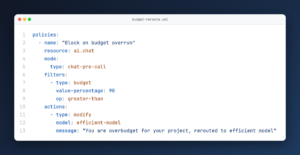
It’s simple enough for a budget rule and expressive enough for complex ones, keyed to whatever your organization tracks. One language works across model providers today, and across gateways over time. Teams learn it once.
Not every team works the same way, and nobody has to write YAML to set a policy. FinOps sets budgets and threshold steps in a Simple view. Switch to Advanced, and the same policy opens as code.

Platform teams write and review policies directly. Anyone can describe a rule in a sentence, like “set a monthly budget of $2,500 per person, warn at 60%, reroute at 100%, and block at 120%,” and Jun0, our AI agent, drafts it.
Three ways in. One language underneath.
Real-time detection
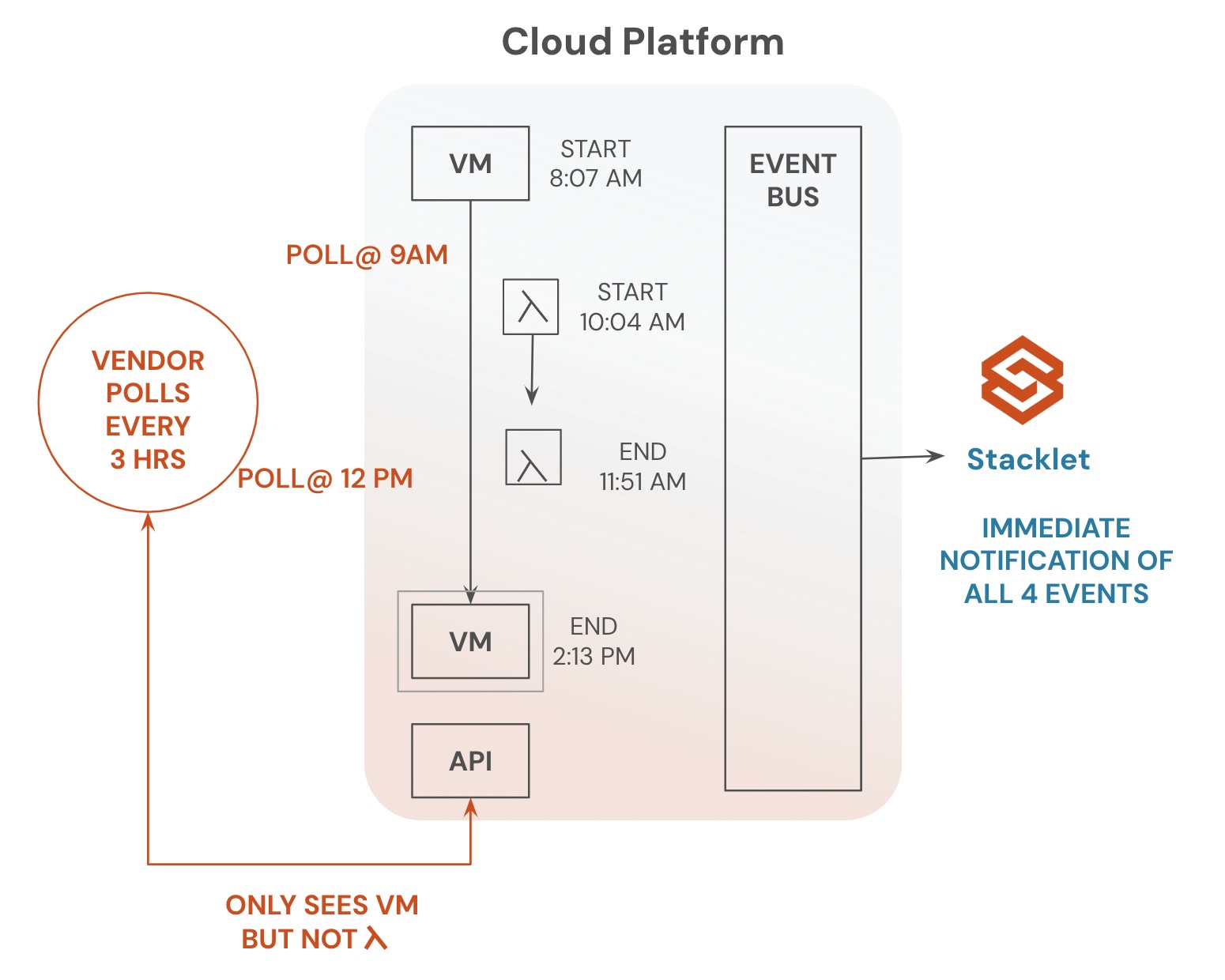
Cloud Custodian was built on cloud APIs and event streams, so a policy could respond to a change as it happened. At Stacklet, we added AssetDB. It watches cloud API calls as they happen and keeps a real-time inventory of every resource, with its owner, cost, and change history, down to who changed it and whether it came from the console or Terraform. Together, they let teams catch a problem and act on it in minutes, before it turned into real cost or risk.
AI needs that speed even more. A token is spent the moment the call is made, so a problem found next week is already paid for. Acting fast starts with knowing whose spend it is. Tokens don’t carry tags the way cloud resources do, so Token Custodian attributes every call to a team, project, and app, using project details like cost center and environment. You see who is spending, on which model, as it happens.
With that in place, patterns show up while they’re still small. A team’s spend climbing ahead of plan. A premium model doing work a lighter one could handle. An agent making far more calls than its task needs. Each one becomes a signal a policy can act on, long before the invoice.
The same live data drives action and reporting. Policies apply best practices in real time, so spend goes to the right work, with the right model and the right settings. FinOps sees the results as they happen. That’s how you get more value from every token.
Built to act
When we built Cloud Custodian, we didn’t want another dashboard to admire problems in. We wanted policies that act on them. For AI, that means acting before the call goes out.
Acting doesn’t have to mean blocking. When a team nears its budget, its requests can move to a lower-cost model, so the work keeps going. A request that doesn’t need deep reasoning can use less of it. A model outside the approved list can be stopped before anyone pays for it. Each is a small change, made in real time.
None of it happens silently. Cloud Custodian was built to teach as it enforced, and Token Custodian works the same way. Every action tells the person what changed and why.
Out of the box, policies cover the basics: approved models, budgets, routing, and reasoning effort. Teams start with best practices by default instead of writing them from scratch.
The same approach extends to newer levers. Prompt caching and compression can cut spend on the right workloads, but today they’re mostly switched on one developer at a time. As policy, the organization decides where they apply, turns them on by default, and sees what they saved. That’s where we’re taking Stacklet Token Custodian next.
Multi-step workflows, where teams work
With Cloud Custodian, automated workflows drove consistency, and they were the only way to scale policy across an enterprise cloud. AI needs them even more. Token spend moves faster than any ticket queue, so the cost of inaction is higher.
We also learned what makes a workflow hold up in an enterprise. It has to be a sequence: warn first, give the owner time to assess or request an exception, then act through automation or a person, depending on what’s at stake. And it has to run where teams already work.
Token Custodian takes the same approach. A few requests need an immediate response. A call to an unapproved model stops before it runs. Everything else follows a workflow.
A team is notified as spend climbs, along with a recommended next step. Closer to the limit, requests shift to lighter options automatically. At the limit, the decision goes to a person: approve more budget, or hold the line. If nobody responds, the workflow escalates on its own.
Exceptions are part of that flow. A product launch, a deadline, an experiment worth the spend. Badly handled exceptions are how governance loses developers, so asking for one has to be fast, and every exception is tracked and reviewed.
Here’s what that looks like for a developer. An engineer in Claude Code is building a checkout feature for an end-of-month launch when the team goes over budget. The session says so right away and moves new requests to a lighter model. If the work needs more, the engineer asks for an exception in the same window, with a one-line reason. The approver gets it in Slack. The engineer can wait for the answer, or move on and hear back in Slack.

No tickets, side scripts, or jumping between tools. Notifications, escalations, and approvals land in coding assistants, Slack, and Jira.
The response also changes by environment. A sandbox and a customer-facing app shouldn’t share a budget or a playbook.
Guardrails, not walls. The work keeps moving, and the spend stays accountable.
Ten years in production
None of this is new to us. Cloud Custodian has run in production for more than ten years as a CNCF project, used by thousands of organizations across every major industry. For more than five years, Stacklet has run it as an enterprise platform.
Ten years taught us the hard parts. How to handle exceptions. How to roll out policy in stages. How to set rules that fit each environment and each team’s needs. How to automate in ways that make teams more efficient and productive. How to write policies that thousands of teams can live with.
Token Custodian starts from that foundation. The unit of spend is new. The lessons about governing it at scale are already learned.
Same job, new unit
Ten years ago, the job was to define what well-managed means and enforce it continuously. That hasn’t changed. Now it covers every token, across every team, app, and agent that spends them.
Join us on October 27 for The Token Governance Summit to see Token Custodian in action. Register Here
Categories
- AI
- AI Governance
- FinOps
- Tokenomics